What Stereolithography is
SLA (Stereolithography) is a 3D printing technology that solidifies liquid photopolymer resin with a UV laser, tracing each layer point by point. It is the oldest additive technology — patented by Chuck Hull in 1986 — and belongs to the photopolymerisation family, the same as DLP. The key difference between the two lies in how the light reaches the resin. While DLP projects a whole image and solidifies the layer in one shot, SLA uses a laser beam steered by galvanometric mirrors that draws the outline and infill of the cross-section like a pen retracing a profile, curing the resin along its path. Most modern desktop machines use the inverted bottom-up configuration: the laser projects from below through the transparent base of the tank, and the platform rises upward, lifting the part.
Why choose it
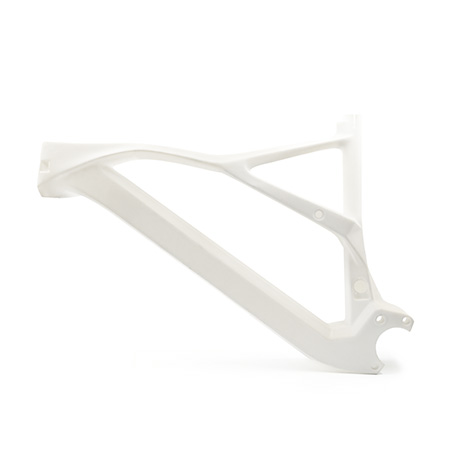
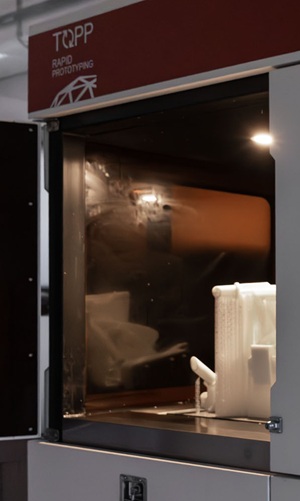
SLA is chosen when finish and fidelity of detail matter more than pure speed. The laser’s focal point defines XY resolution continuously, without the pixel quantisation typical of a DLP projector: no “voxel” effect on the edges, cleaner contours and smoother surfaces. This is why SLA remains the reference standard for very-high-fidelity applications. The trade-off is time. Because the laser traces point by point, the duration of a layer depends on how much area it has to cover, whereas in DLP it is constant because everything is flashed at once: for small, isolated parts the two technologies are comparable, but on dense layers or plates full of parts DLP is faster. When the goal is surface quality, however, SLA remains the better choice. At TOPP Rapid Prototyping dimensions are not a problem: our SLA system builds parts up to 3000 mm long in a single piece, with no joints.
Typical applications
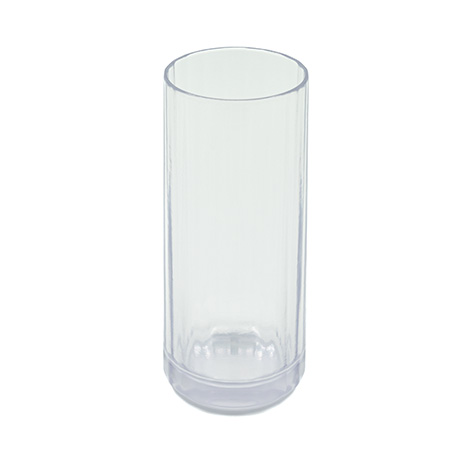
SLA is at its best where fine detail and a refined aesthetic finish are needed. Its natural fields are dentistry (models and guides), jewellery and patterns for lost-wax casting, aesthetic prototypes and presentation models, and masters for making silicone moulds. In general, any context where geometric fidelity and surface cleanliness matter more than mechanical strength or production speed.