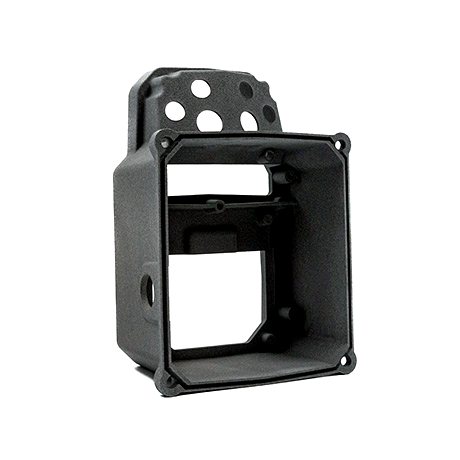
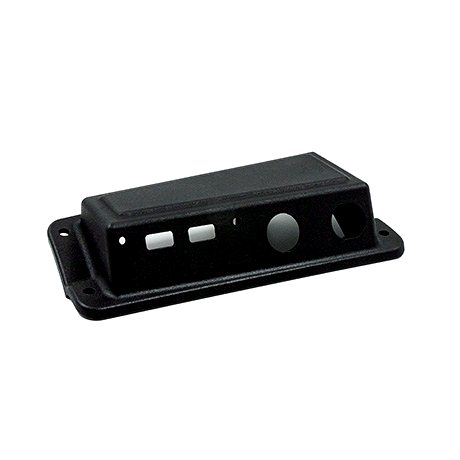
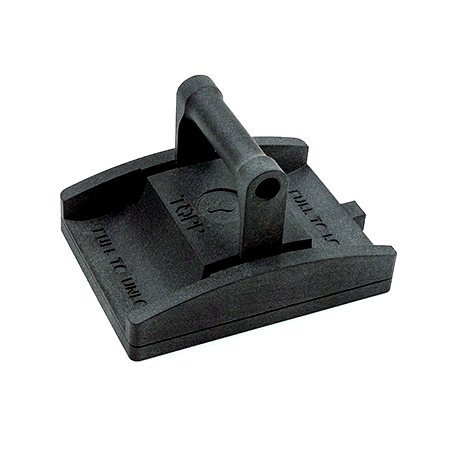
Post-processing covers the finishing operations applied to parts after 3D printing — sandblasting, sanding, painting, metallisation, dyeing and bonding — that improve aesthetics, function and strength to the required final result.
What post-processing is
Post-processing covers the finishing operations applied to parts after 3D printing, to take them from the raw “as-machined” look to the required aesthetic and functional result. Almost no additive technology returns a part that is ready to use: layer lines, porous surfaces, support attachment points and neutral base colours are the norm — and it is precisely these aspects that finishing addresses.
The main operations
The most common, often combined in sequence, are:
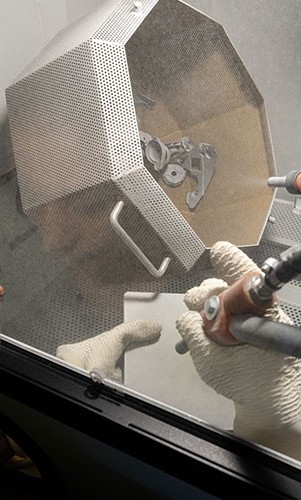
- Sandblasting — a jet of micro-granules evens out the surface, removes residual powder (typical on SLS and MJF) and gives a uniform matte look.
- Sanding and abrasion — reduce or eliminate layer lines, preparing the part for painting.
- Painting and lacquering — provide colour, protection and the desired finish (matte, gloss, soft-touch), usually after applying a primer.
- Dyeing — immersion in a colour bath absorbed deep into the material, particularly effective on porous nylon parts.
- Metallisation — deposition of a metal layer for aesthetics (chrome effect) or function (EMI shielding, conductivity).
- Bonding and assembly — joining several separately printed components to overcome volume limits or simplify geometries.
When they are needed
Finishing is chosen according to the part’s requirements. An aesthetic prototype or presentation model needs sanding and painting to hide the layers; a functional component may need metallisation for conductivity or shielding, or bonding for assembly; SLS nylon parts often go through sandblasting and dyeing for a uniform look. Not every part, however, needs finishing: where only function matters, the raw printed surface is often already enough, and every additional operation should be weighed against the result it has to deliver.
FAQ
Which finishes are available after 3D printing?
Among the most common: sandblasting, sanding, painting and lacquering, dyeing, metallisation and bonding of multiple components, depending on the aesthetic and functional requirements of the part.
Does every part need finishing?
No. Where only function matters, the raw printed surface is often already enough. Finishing is applied when you need a refined appearance, a specific colour or properties that printing alone does not give (conductivity, sealing, surface resistance).
Does finishing affect tolerances?
Yes. Sanding and sandblasting remove material, painting and metallisation add it, in the order of a few tenths of a millimetre. If tolerances are tight this must be planned at the design stage, by oversizing or masking the critical areas.
Can a coloured part be produced?
Yes, in two main ways: dyeing, which immerses the part in a colour bath absorbed deep into the material (effective on the porous nylons of SLS and MJF), and painting, which applies a surface layer of colour with the desired finish (matte, gloss, soft-touch).
What is metallisation and what is it for?
It is the deposition of a thin metal layer on the part. It serves both aesthetic purposes (chrome or metallic effect) and functional ones, for example electromagnetic shielding (EMI) or making a plastic surface conductive.
Can several printed parts be joined?
Yes. Structural bonding allows separately printed components to be assembled, overcoming the machine's volume limits or simplifying geometries that would be difficult to print in a single piece.