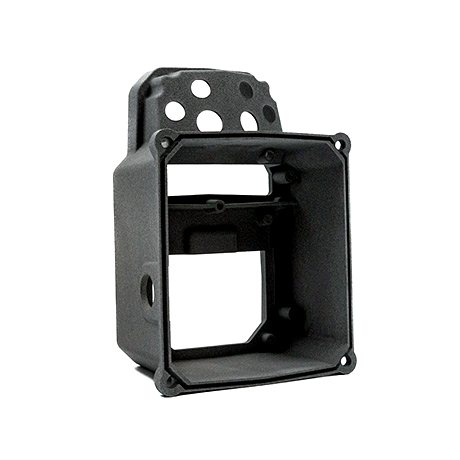
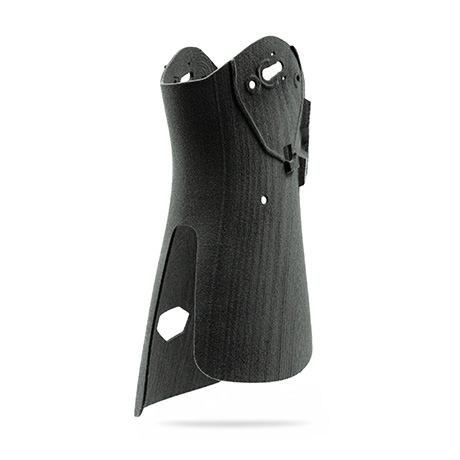
Multi Jet Fusion (MJF) is an HP powder-bed 3D printing technology that fuses PA12 polyamide powder layer by layer using fusing agents and infrared heat, producing strong, near-isotropic functional parts with fine detail, ready for mechanical testing and short-run production.
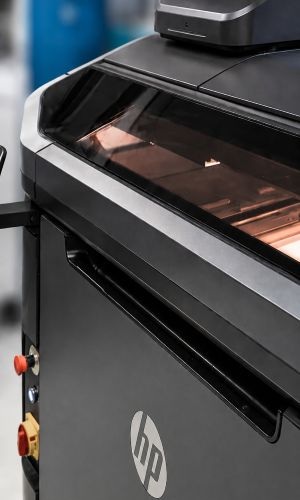
What Multi Jet Fusion is
Multi Jet Fusion is a powder-bed fusion process in which a printhead selectively deposits a fusing agent (and a detailing agent at the edges) onto a layer of PA12 powder; an infrared source then fuses the treated areas. Repeating the cycle layer by layer yields the solid part embedded in the unfused powder, which acts as support.
Why choose it
Compared with other additive technologies, MJF delivers parts with near-isotropic mechanical properties and a uniform surface, with short production times because the whole build volume is processed in a single run. It is the typical choice for functional prototypes, brackets, housings and components destined for mechanical testing or short-run production.
Typical applications
With MJF we produce components for testing mechanical functionality, technical housings and parts intended for assembly verification, drawing on the experience we have built up since the 1990s in prototype engineering.
FAQ
Which materials are used in Multi Jet Fusion?
The standard material is PA12 polyamide (nylon), also available in filled grades (e.g. glass-bead PA12) and PA11 for higher ductility. Grey or black finishes and post-process colouring are possible.
What tolerances and detail does MJF achieve?
Typical layer thickness is about 0.08 mm, with minimum features around 0.5 mm and dimensional tolerances generally within ±0.3 mm or ±0.3% of the largest dimension, depending on geometry.
When should I choose MJF over SLS or FDM?
MJF is preferable when you need functional parts with homogeneous mechanical properties, good repeatability and small-batch productivity thanks to build-volume saturation. For purely aesthetic parts or low-cost rapid prototypes, SLA/DLP or FDM may suit better.
Is MJF suitable for series production?
Yes, for small and medium series. Nesting many parts in the same build volume makes the cost per part competitive, while keeping end-use mechanical properties.